
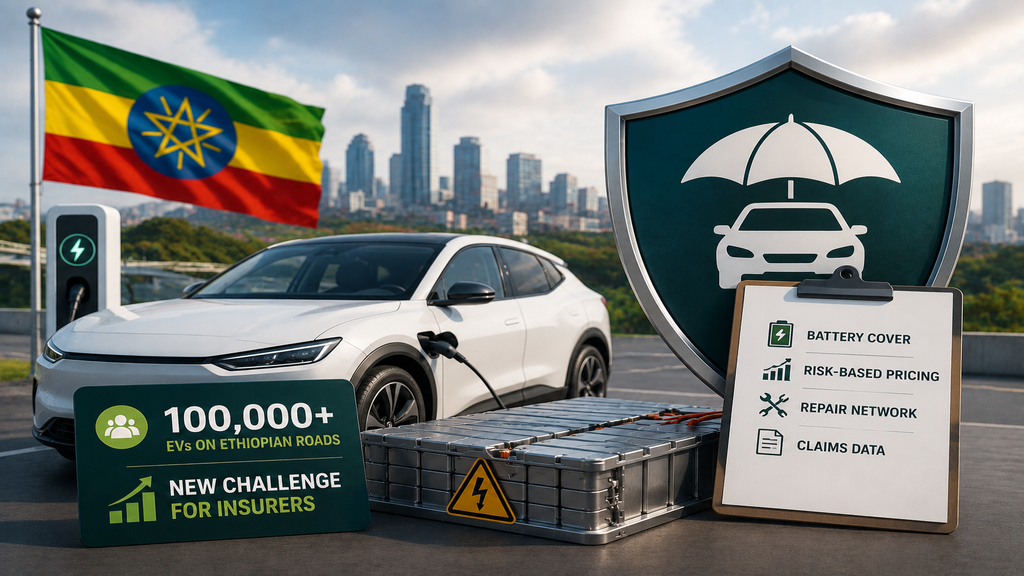
Key Takeaways:
• 100,000 EVs — estimated electric vehicles in circulation, below 5% of Ethiopia’s total fleet.
• NBE says high EV spare-part costs make minimum premium pricing difficult for insurers.
• Batteries account for up to 50% of an EV’s value, according to industry experts.
• EV battery total-loss endorsements require customers to contribute about 25% to 30%.
• Ethiopia’s insurance industry assets rose to Birr 78.26bn by June 2025.
• Motor insurance generated Birr 18.74bn in gross premiums, 50.53% of industry premiums.
• Industry experts urge EV-specific underwriting, after-sales rules and a centralised claims database.
Market Impact:
Ethiopia’s EV transition is creating a new pricing challenge for insurers whose motor policies were built around internal-combustion vehicles. Although EVs remain less than 5% of the national fleet, high battery values, scarce parts, limited repair capacity and weak historical claims data are already complicating underwriting and claims settlement.
The pressure is concentrated in motor insurance, the sector’s largest premium source and its largest claims line. Motor cover generated Birr 18.74 billion in gross premiums but paid Birr 6.19 billion in claims, making EV repair-cost escalation a balance-sheet issue for insurers.
The regulatory question is whether minimum premium rules can accommodate a vehicle class whose repair economics differ sharply by brand, battery condition, dealer support and parts availability. Insurers are likely to push toward risk-based pricing, clearer battery coverage, after-sales requirements for importers and stronger local repair capacity.
Key Numbers:
100,000 EVs — Estimated EVs in circulation — emerging insurance exposure
Below 5% — EV share of total fleet — small but disruptive risk pool
Birr 200,000 — Compulsory third-party liability limit — property damage and bodily injury cover
25%–30% — Customer contribution for battery total loss — cost-sharing exposure
10%–15% — Customer contribution for battery damage — claims-cost sharing
Birr 10,000–15,000 — Accident deductibles — claims participation level
1.01% — NBE minimum rate cited for some vehicles — regulated pricing floor
2%–2.5% — Premium range for selected EVs — risk-adjusted pricing signal
22 companies — Ethiopia’s insurance industry count — market structure
Birr 78.26bn — Industry assets — balance-sheet scale
Birr 15.85bn — Paid-up capital — sector capital base
Birr 7.44bn — After-tax profit — industry profitability
Birr 18.74bn — Motor gross premiums — largest business line
50.53% — Motor share of industry premiums — portfolio concentration
Birr 6.19bn — Motor claims paid — largest claims exposure
54.02% — Motor share of industry claims — claims concentration
Birr 9.88bn — Motor insurance service result — underwriting outcome
Business Signal:
Ethiopia’s EV shift is forcing insurers to redesign motor underwriting around battery risk, parts availability, dealer support and claims data rather than conventional vehicle categories alone.