
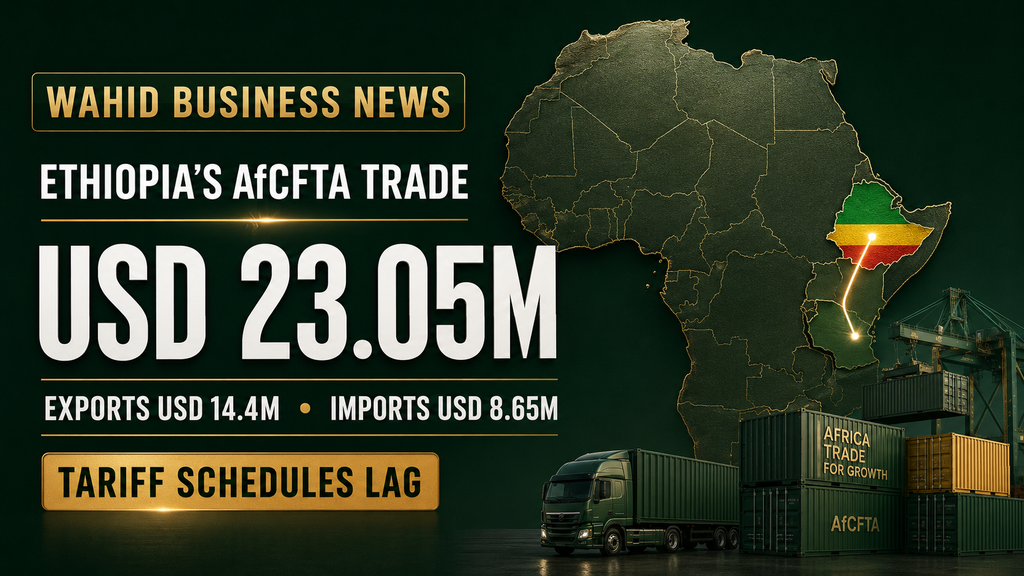
USD 23.05m — Reported AfCFTA trade comprised USD 14.4m in exports and USD 8.65m in imports.
USD 5.75m surplus — Calculated trade balance between October 2025 and May 2026.
92.7% — Kenya’s share of Ethiopia’s AfCFTA exports, based on the reported figures.
16 of 50 — Submitted tariff schedules cover all goods categories; 25 have been officially gazetted.
37 exporters — Participating companies compared with 76 importers under the framework.
NUMBERS AND TREND SNAPSHOT
| Indicator | Current figure | Previous/target | Significance |
|---|---|---|---|
| Total AfCFTA trade | USD 23.05m | Not specified | Exports plus imports |
| Exports | USD 14.4m | Broadly similar* | Seven destination countries |
| Imports | USD 8.65m | Not specified | Sourced from four countries |
| Trade balance | USD 5.75m surplus | Not specified | Based on reported figures |
| Kenya export share | 92.7% | Not specified | USD 13.35m of exports |
| Complete tariff schedules | 16 of 50 | 50 submitted | 32% cover all categories |
SUMMARY
Ethiopia recorded approximately USD 23.05 million in trade under the African Continental Free Trade Area between October 2025 and May 2026, according to a Ministry of Trade and Regional Integration document obtained by The Reporter Ethiopia. Exports exceeded USD 14.4 million, while imports totalled about USD 8.65 million, producing a calculated trade surplus of approximately USD 5.75 million.
Kenya received USD 13.35 million of Ethiopia’s AfCFTA exports—approximately 92.7% based on the reported figures. The remaining six destinations collectively received just over USD 1 million. Oilseeds and related products generated nearly USD 5.7 million, followed by maize at almost USD 900,000 and detergents and chemical products at USD 780,000.
Implementation remains incomplete across the continent. Although 50 countries submitted goods tariff schedules and 49 reportedly secured technical clearance and ministerial approval, only 16 schedules cover all product categories and 25 have been officially gazetted. Ethiopia has prepared its goods and services schedules and approved a national implementation strategy, but the report does not clarify whether its complete tariff schedule has been gazetted and fully implemented by customs authorities.
WHY IT MATTERS
The reported surplus represents a positive foreign-exchange contribution, although its significance relative to Ethiopia’s overall trade was not provided. Heavy dependence on Kenya and oilseeds indicates limited market and product diversification under the framework. Incomplete tariff publication can create uncertainty over preferential rates and restrict practical use by traders. Businesses should monitor whether customs implementation and additional tariff schedules translate into more destinations, products and participating companies.