
Key Takeaways:
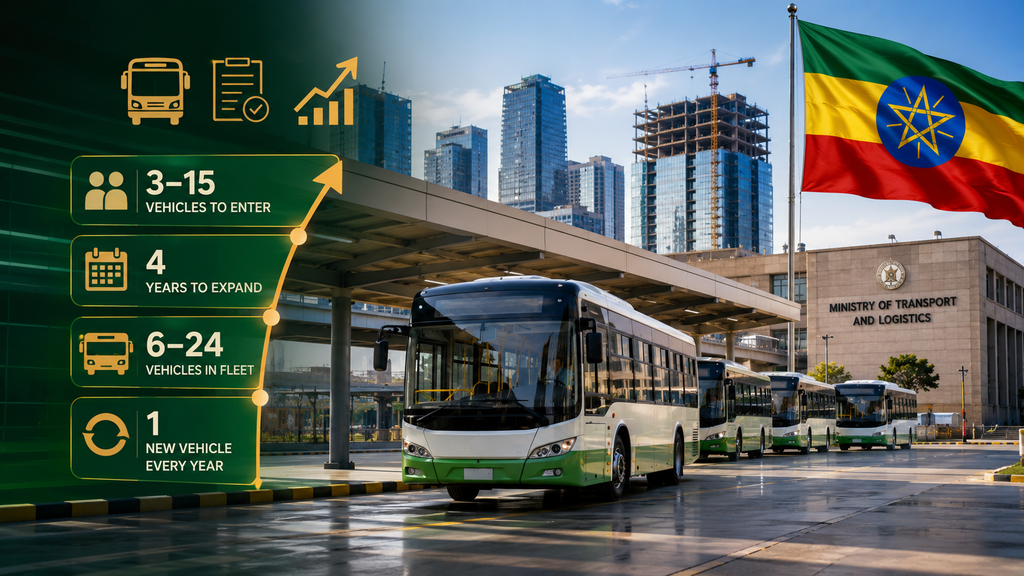
• 3–15 vehicles can now qualify operators for entry, depending on commercial bus service category.
• Ministry of Transport and Logistics issued Directive No. 1136/2026 in May.
• Directive No. 1136/2026 amends Directive No. 984/2024 for commercial bus licensing.
• Operators must expand fleets over four years to reach six to 24 vehicles.
• Fifth-year rules require operators to add at least one new vehicle annually.
• Leased buses may supplement registered fleets under certified agreements and age requirements.
• Fare bands set Level 2 fares 15% below Level 1 and Level 3 fares 10% below Level 2.
Market Impact:
The directive lowers the capital threshold for entering Ethiopia’s commercial bus market while retaining a staged compliance regime. This could widen participation among operators that were previously constrained by high upfront fleet requirements.
The reform also shifts the regulatory burden from immediate scale to continuous fleet renewal. For vehicle suppliers, financiers and leasing providers, the annual addition requirement creates a longer-term demand channel for new buses.
Standardised fare bands and digital monitoring requirements point to tighter state oversight of pricing, reporting and service compliance. Operators gain easier entry, but face more structured supervision once licensed.
Key Numbers:
3–15 vehicles — new entry fleet threshold — lowers upfront capital burden
30 vehicles — previous higher fleet requirement — shows scale of regulatory easing
4 years — fleet expansion period — extends compliance timeline
6–24 vehicles — required fleet size after expansion — preserves growth obligation
1 new vehicle annually — fifth-year requirement — embeds rolling fleet renewal
15% — Level 2 fare discount to Level 1 — standardises pricing gap
25% — gap between highest and lowest tiers — limits pricing discretion
Business Signal:
Ethiopia is easing entry into commercial bus operations while tightening long-term fleet renewal, fare control and compliance oversight.