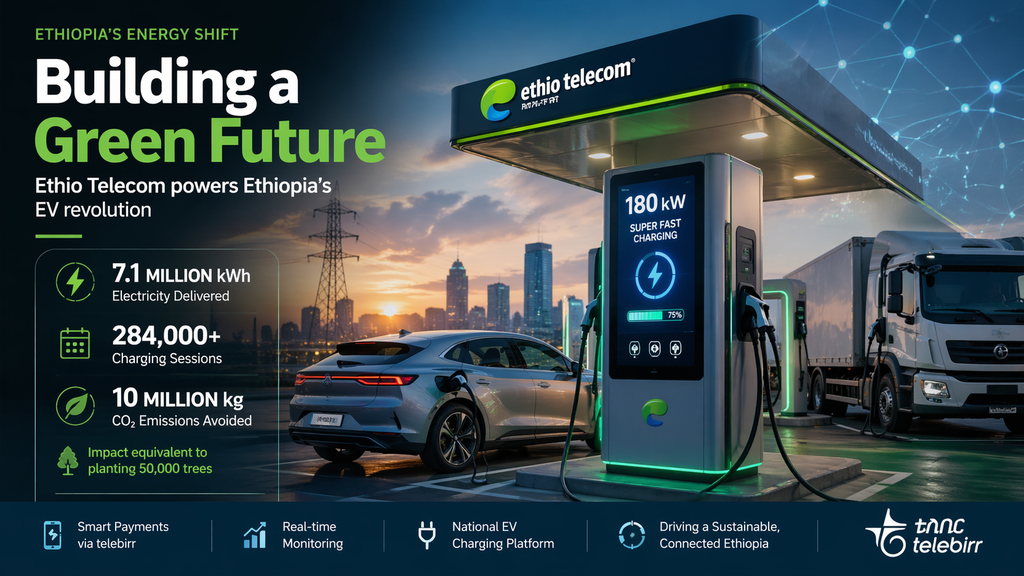
Ethio telecom opened its fourth public super-fast EV charging station in Adama, first expansion outside Addis Ababa.
The Adama site uses 180 kW chargers and helps raise network capacity to charge 60 vehicles simultaneously.
Since February 2025, the charging network has recorded more than 284,000 charging sessions.
The network has delivered over 7.1 million kWh of electricity through its EV charging infrastructure.
The rollout has avoided over 10 million kilograms of CO2 emissions, linked to an impact equivalent to planting 50,000 trees.
Integration with Telebirr enables NFC Tap-to-Charge payments, real-time monitoring, and automated charging transactions.
Ethio telecom launched a National EV Charging Platform to let third-party operators connect into a unified charging network.
The expansion aligns with the “Next Horizon: Digital and Beyond 2028” strategy, linking telecom infrastructure, payments, and energy systems.
Why It Matters?
This signals movement from pilot-stage EV infrastructure toward scalable national charging deployment in Ethiopia. It lowers infrastructure barriers for electric transport, while opening opportunities for private charging operators, equipment suppliers, and digital payment ecosystems. For logistics, energy, and mobility investors, the story is less telecom diversification than infrastructure platform creation.
Electric
Ethio Telecom Scales National EV Platform as 284,000 Charging Sessions Signal Energy Shift