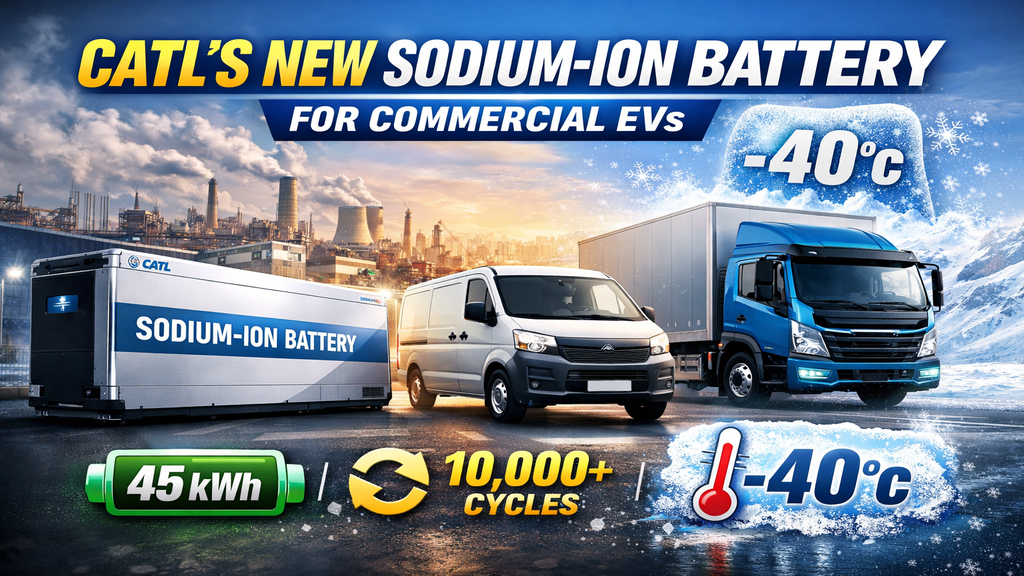
CATL officially introduced the Tianxing II battery series on January 22, 2026, highlighting a new sodium-ion variant.
The 45 kWh sodium-ion battery is designed specifically for small vans, micro vans, and light trucks.
The battery achieves energy density of 175 Wh/kg and a cycle life exceeding 10,000 cycles.
It is the industry’s first mass-produced sodium-ion battery for commercial vehicles.
The battery received GB 38031-2025 certification, China’s new national EV battery standard.
In extreme cold of -40 °C, the battery retains about 90 % usable capacity.
The pack supports immediate charging at -30 °C, addressing winter operation challenges.
The Tianxing II lineup includes four versions: low-temperature (sodium), fast-charging, long-range, and high-temperature fast-charging variants.
The long-range variant offers up to 253 kWh capacity with ≈800 km range for logistics use.
Sodium is >1,000× more abundant and ~1/20 the extraction cost of lithium, implying future cost advantages.
Implications of CATL’s mass-produced sodium-ion battery announcement for the Ethiopian market:
Potential cost reduction in EV fleets: Sodium-ion batteries use abundant sodium instead of lithium, which could lower battery and thus EV costs if adopted regionally.
Enhanced cold-weather performance: The new battery’s ability to retain performance in low temperatures could benefit logistics and commercial EV use in highland and variable climates.
Acceleration of commercial EV adoption: With Ethiopia rapidly increasing electric vehicle numbers (over 115,000 EVs) and policy support for EVs, more affordable, durable batteries support this growth trajectory.
Encouragement for local infrastructure investment: The technology spotlight may incentivize expansion of charging and service networks, addressing current shortages that limit EV use outside Addis Ababa.
Opportunity for domestic participation: As Ethiopia explores local EV and battery industries and assembly initiatives, sodium-ion technology can present a simpler, potentially more accessible entry point for manufacturing and skills development.
Electric
CATL Unveils First Mass-Produced Sodium-Ion Battery for Commercial EVs